
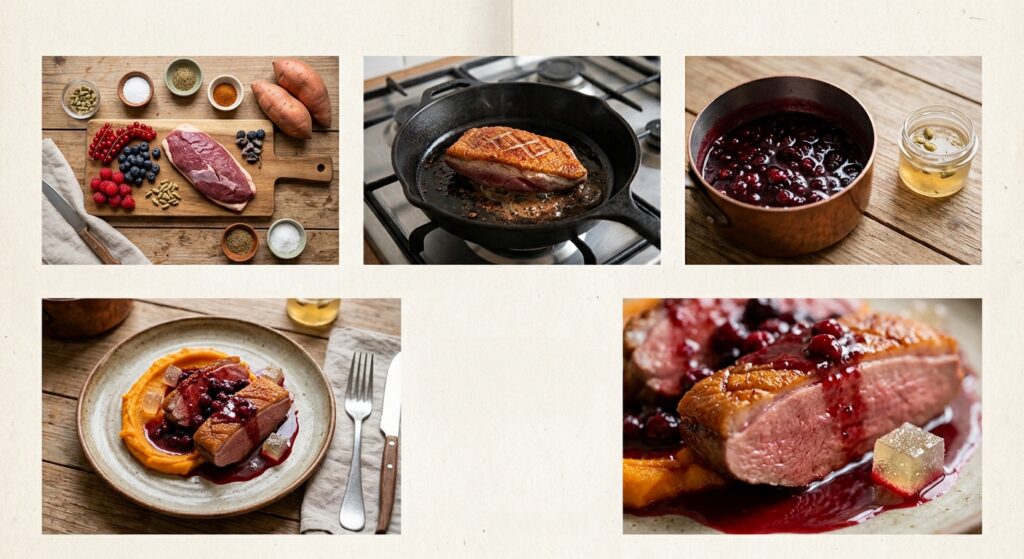
I propose a restaurant-style version that is perfectly achievable at home: the duck magret remains succulent, the reduction provides acidity and depth, the cardamom gelée introduces an aromatic contrast, and the sweet potato parmentier brings sweetness and a beautifully smooth texture.
Key utensils
- Heavy-based frying pan — essential for cooking the duck magret properly.
- Small saucepan for the reduction and gelée.
- Medium saucepan for the parmentier.
- Fine-mesh sieve.
- Stick blender or potato ricer.
- Kitchen thermometer — highly recommended for controlling the exact doneness of the duck.
- Chopping board and sharp knife.
- Spatula.
- 4 serving plates.
Ingredients for 4 people
Duck magret
- 2 duck magrets, 350 g each
- Fine sea salt: 6 g
- Freshly ground black pepper: 1.5 g
Red berry reduction
- Mixed frozen berries: 250 g
- Red wine: 180 ml
- Chicken stock: 150 ml
- Shallot: 60 g
- Honey: 25 g
- Sherry vinegar: 20 ml
- Unsalted cold butter: 25 g
- Fresh thyme: 3 g
- Fine sea salt: 2 g
Cardamom gelée
- Water: 200 ml
- Dry white wine: 50 ml
- Caster sugar: 20 g
- Lemon juice: 15 ml
- Green cardamom pods: 6
- Leaf gelatine: 4 g
Sweet potato parmentier
- Peeled sweet potato: 700 g
- Unsalted butter: 60 g
- Double cream: 100 ml
- Whole milk: 50 ml
- Fine sea salt: 5 g
- Ground nutmeg: 0.5 g
- Ground white pepper: 0.5 g
To finish
- Fresh berries: 80 g
- Microgreens or tender shoots: 20 g
Step-by-step preparation
1. Prepare the cardamom gelée — 15 minutes
- Place 4 g of leaf gelatine in a bowl with 100 ml of cold water for 8 minutes.
- Lightly crush the 6 cardamom pods using the flat side of a knife.
- Place 200 ml of water, 50 ml of white wine, 20 g of caster sugar, 15 ml of lemon juice, and the cardamom in a saucepan.
- Heat over medium heat for 4 minutes, until the mixture reaches approximately 85°C, without allowing it to boil.
- Remove from the heat and leave to infuse for 5 minutes.
- Remove the cardamom and pass the liquid through a fine-mesh sieve.
- Squeeze out the gelatine, add it to the hot liquid and stir for 1 minute until completely dissolved.
- Pour the mixture into a container, creating a layer approximately 5-8 mm thick.
- Refrigerate for at least 2 hours at 4°C.
2. Prepare the sweet potato parmentier — 35 minutes
- Cut the 700 g of sweet potato into approximately 3 cm cubes.
- Place the sweet potato in a saucepan and cover with cold water.
- Add 5 g of salt.
- Bring to the boil over high heat for approximately 5 minutes.
- Once boiling, reduce to medium-low heat and cook for 20 minutes, until the sweet potato can be easily pierced with a knife.
- Drain thoroughly and return the sweet potato to the saucepan.
- Cook over low heat for 2 minutes, stirring, to evaporate any excess moisture.
- Separately, heat 100 ml of double cream and 50 ml of milk to 70°C for 3 minutes.
- Blend the sweet potato with 60 g of butter.
- Gradually incorporate the hot cream and milk mixture over 2 minutes, until smooth and creamy.
- Add 0.5 g of nutmeg and 0.5 g of white pepper.
- Keep covered at 60-65°C until serving.
3. Prepare the red berry reduction — 20 minutes
- Finely chop 60 g of shallot.
- Place the shallot in a saucepan with 180 ml of red wine, 150 ml of chicken stock, 25 g of honey, 20 ml of sherry vinegar, 3 g of thyme, and 2 g of salt.
- Cook over medium-high heat for 8 minutes.
- Add the 250 g of frozen berries.
- Reduce over medium heat for 7 minutes, stirring every 2 minutes.
- Remove the thyme and pass the sauce through a fine-mesh sieve, gently pressing the berries to extract their juices.
- Return the sauce to the saucepan and reduce over medium heat for 3 minutes, until it reaches a slightly syrupy consistency.
- Remove from the heat and emulsify with 25 g of cold butter, adding it in small cubes over 1 minute.
Desired result: a glossy sauce, thick enough to lightly coat the back of a spoon, but still fluid.
4. Cook the duck magret — 18 minutes
- Thoroughly pat the 2 duck magrets, 350 g each, dry with kitchen paper.
- Using a sharp knife, score the skin diagonally to create a diamond pattern. Cut through the skin and fat, without reaching the meat.
- Season the meat with 6 g of salt and 1.5 g of pepper.
- Place the magrets skin-side down in a cold frying pan, without adding oil.
- Turn the heat to medium-low.
- Cook for 8 minutes, allowing the fat to render slowly.
- Remove the excess fat from the pan, leaving approximately 10 ml.
- Turn the magrets over and cook the meat side over medium heat for 3 minutes.
- Return the magrets skin-side down and cook for 2 minutes over medium heat to restore the crispness.
- Remove from the heat when the centre reaches 54-55°C.
- Place the magrets on a chopping board and leave to rest for 5 minutes before slicing.
During the resting period, the internal temperature will continue to rise slightly and the juices will redistribute.
5. Plating — 5 minutes
- Warm the plates for 3 minutes at 60°C, if they are oven-safe.
- Place approximately 175 g of sweet potato parmentier on each plate.
- Cut each magret into 8-10 slices, approximately 1 cm thick.
- Arrange half a magret per person over the parmentier, with the crispy skin facing upwards.
- Add approximately 60-65 ml of red berry reduction around and partially over the duck.
- Cut the cardamom gelée into small 5-8 mm cubes and place approximately 25-30 g per plate.
- Finish each plate with 20 g of fresh berries and 5 g of microgreens.
⭐ Chef’s tip
The key is to start the magret in a completely cold frying pan with the skin facing down. Gradual heating allows the fat to render without burning the skin. To achieve an especially crisp skin, do not press the magret against the pan: let the rendered fat do the work.
And there is a second important detail: do not slice the duck immediately after cooking it. The 5-minute resting period is essential for keeping the meat juicy and preventing the juices from ending up on the chopping board instead of on the plate.
Final result: silky and sweet parmentier → juicy, crispy-skinned duck magret → intense, slightly acidic red berry reduction → small bites of aromatic cardamom gelée that refresh the palate.